Our Books

ACFA Field Archaeology for All, Our Books

ACFA has a history of producing occasional papers, publishing the results of our surveys. We have
also branched out into publishing books based on these surveys, synthesising and building on the
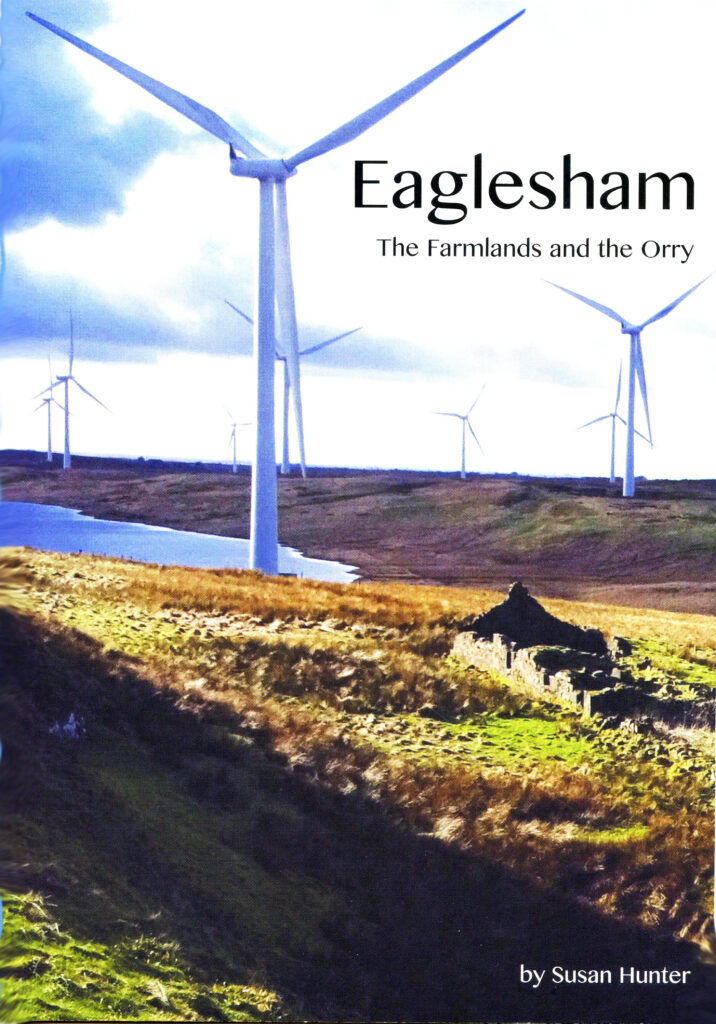
information recorded. The first of these, Eaglesham The Farmlands and the Orry, by Susan Hunter,
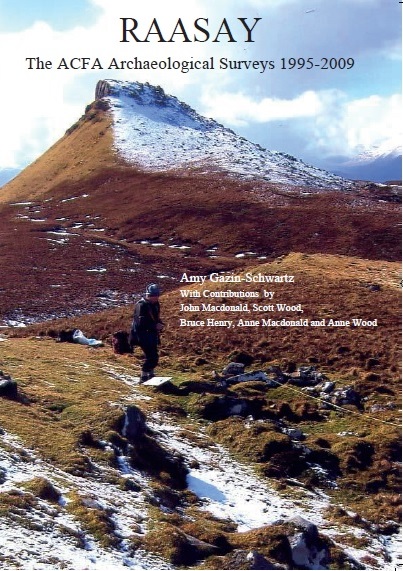
was published in 2016, followed in 2018 by Raasay, by Amy Gazin Schwartz.
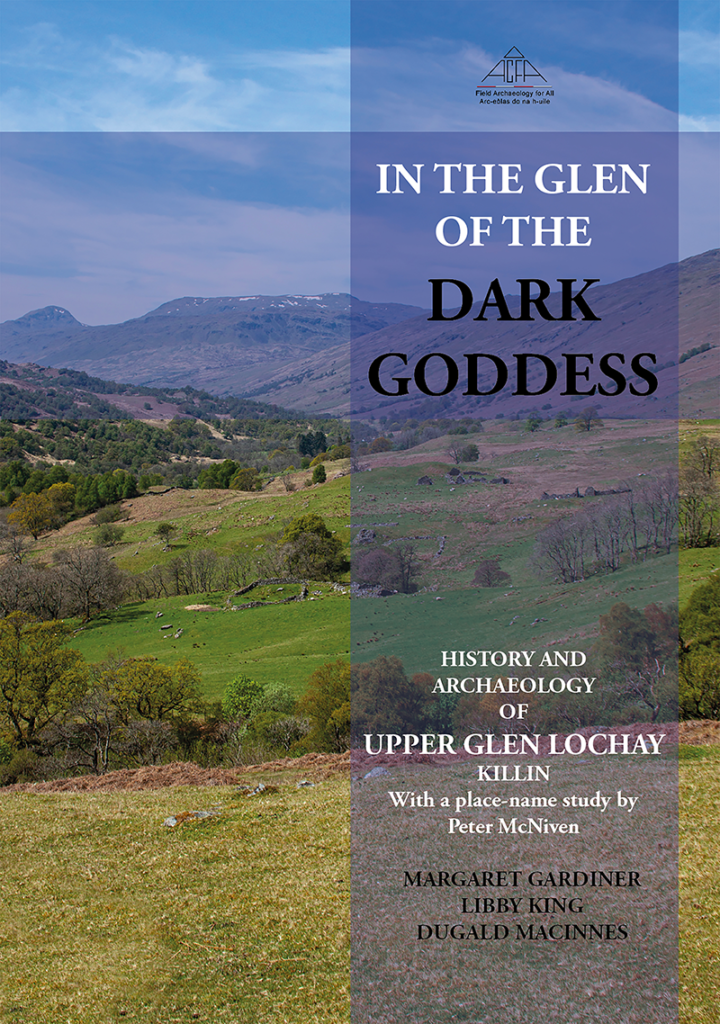
Glen of the Dark Goddess by Dugald MacInnes, Margaret Gardiner and Libby King was published in 2024. The latest addition to the list is Two Headlands: The Archaeology of Ben Hynish and Kenavara, Isle of Tiree, edited by John Holliday and Dugald MacInnes.

Two Headlands

Authors: John Holliday and Dugald MacInnes
Format: A4
ISBN: 978-1-0681997-0-7
Pages: 461
Illustrations and photographs: 482
Tables: 32  

Two Headlands: The archaeology of Ben Hynish and Kenavara, Isle of Tiree

Two Headlands reports on the first major archaeological programme on Tiree for 60 years.

The core of this eight-year project has been the methodical recording of the landscape archaeology of two headlands on Tiree, Ben Hynish and Kenavara. The work has been carried out by members of ACFA – Field Archaeology for All/Arc-eòlas do na h-uile with the support of a number of professional archaeologists. Although the Royal Commission surveyed the area in the 1970s, over 800 archaeological features were recorded for the first time. The most interesting are presented here. These features range from late prehistoric cairns to five Iron Age duns and forts; an Early Christian eremitic monastery; medieval houses; huts and shieling settlements; kelp processing sites; an aqueduct built by Alan Stevenson in 1843; and sheepfolds dating from the second half of the nineteenth century.

Using a novel methodology, a detailed survey of the field dykes covering Ben Hynish has also revealed several overlapping field systems. A network of orthostatic dykes covers the 330-hectare site. It is suggested that these may be late prehistoric. The survey has also revealed Tiree’s only surviving medieval hill farm, and a soil survey has shown that its closed fields contain deep plaggen-type soils.

Almost 5000 worked lithics were recovered. Analysis shows that these date from the Late Mesolithic to the Bronze Age. The recovery of a possible Late Upper Palaeolithic crested blade supports earlier evidence that some of the first people to settle Scotland after the last Ice Age visited Tiree. A number of coarse stone tools were also found, including the island’s first documented Skaill knife. The discovery of a number of trough querns shows that the Bronze Age people who lived on Ben Hynish grew cereals. The ceramics found in the survey areas included some diagnostic Iron Age material. A limited excavation of the midden of one of the duns has recovered material dated securely to the Iron Age and a possible pottery gaming piece.

The book also includes the first full account of the island’s prehistory, a detailed history of the two headlands and their surrounding settlements, and an analysis of the place-names and oral traditions of Ben Hynish.

The work is a testament to the skill and dedication of a team of largely non-professional archaeologists and represents an important contribution to our understanding of the archaeology of the region. Lavishly illustrated with 482 illustrations, some using a drone, this is a book for anyone interested in the archaeology of Tiree and of the Hebrides more generally.

With contributions from Ann Clarke (lithics), Ann MacSween (pottery), Darko Maričević (archaeological overview), Bob Chambers (farm to township history), Diana Zilioli (soil analysis), Heather James (excavation), Ailsa and Ed Smith (field dykes).

Costs £40 including P&P to UK addresses. For delivery to the rest of the world, or for orders of more than one copy, please contact us.


cards

Powered by paypal

In the Glen of the Dark Goddess

with a Place-Name study by Peter McNiven. 

Screenshot

Authors: Margaret Gardiner, Libby King and Dugald MacInnes
Format: A4
ISBN: 978-1-8384166-7-6 
Pages: 388
Colour illustrations: 141
B&W illustrations: 4
Plans of key features: 22
Tables: 24  
Maps and plans: 43 

In the Glen of the Dark Goddess 
A history and archaeology of Upper Glen Lochay, Killin. 

This is a story of the upper part of a small Scottish glen, a ‘glen within a glen’ separated from the lower portion by a narrow gorge.

It is an account of its archaeology from prehistory to the twentieth century with highlights from the Neolithic including rock art and a long cairn; from the Bronze Age hut circles and from the Iron age a fine example of a round house.

Later archaeology includes the remains of post medieval settlement, improvements of the eighteenth and nineteenth centuries and the Breadalbane Hydro Electric Scheme of the 1950s.

It is also a tale of the ordinary people who lived and eked out an existence in the glen: Browns, Campbells, Camerons, Fergusons, MacArthurs, MacCallums,  MacDiarmids, MacDonalds, MacGregors, MacIans, MacKerchars, MacMartins, MacNabs, MacNaughtons, MacVeans, Menzies, Robertsons, Stewarts or Stuarts and a host of other family names.

The authors, amateur archaeologists and historians, have helped in recording  the archaeology of the glen spanning a period of nearly thirty years and spent two decades researching archival material.

It is hoped that the book will be of interest not only locally and to those with historical connections to the area, but also to a wider audience, particularly those fascinated by the history of the day-to-day lives of the people of Scotland.

Costs £25 including P&P to UK addresses. For delivery to the rest of the world, or for orders of more than two copies, please contact us.

Scroll to Top