ACFA was approached by Colin Davenport of Bannockburn House Trust to carry out a walk-over survey of the grounds of the house. A team from ACFA undertook the survey in March 2023, guided by Colin Davenport. The aim was to confirm the known archaeology and identify any other features. There is evidence of coal extraction with known mine sites and a wagonway. Two features were noted and recorded: a linear feature presenting as a ditch, and a dyke.
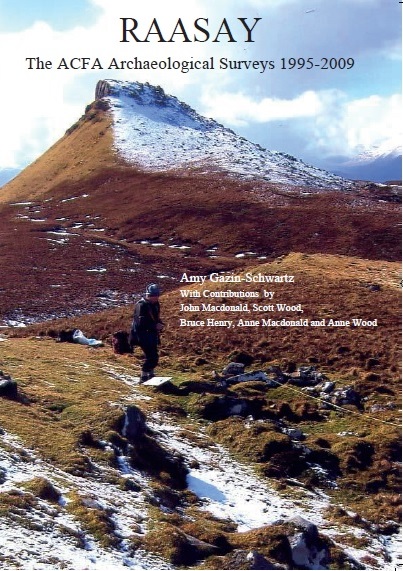
The isle of Raasay holds a rich tapestry of archaeological remains that document how people lived and worked on the island for the last 10,000 years. Raasay: The ACFA Archaeological Surveys 1995-2009 brings together the results of annual surveys of the island conducted by members of the Association of Certificated Field Archaeologists, under the joint direction of John MacDonald and Scott Wood. Combining an analysis of the archaeological data with historical documents, oral traditions, and insights from the people who live on Raasay, the book provides a detailed description of the archaeology of the island, and aims to demonstrate the value of detailed, but low-tech archaeological field survey for discovering and understanding the past.
Price including postage and packing £25 to UK addresses. For delivery to the rest of the world please contact us. Last few copies available.
On my 40th birthday in 1978 I sat in Lionel Master’s office waiting room waiting for my interview to join the course. Opposite me was a rather grumpy chap who had apparently misread his letter and had been waiting for a very long time – Scott Wood. The next time we met was October of the same year when I started the course – the Certificate in Field Archaeology – alongside a somewhat less grumpy Scott Wood.
Over the next 3 years I was in awe of Scott’s ability to produce a drawing as if by magic while I was still trying to figure out which end of a pencil to use! Over the years of the course I got to know Scott better particularly during the fieldwork weeks when we socialised and shared many a pint of an evening. Sadly, the course came to an end in 1981 and the group went its separate ways, but Scott and I remained friends.
In 1987 Lionel wrote to all the certificate holders suggesting a meeting of those interested in forming a group and so ACFA was born!
Scott and I sat on the very first committee and ACFA was given a project by Carol Swanson, who had also been on our course and went on to become the Regional Archaeologist for Strathclyde. The Scottish Coal Board asked for a survey of the area at Chalmerston near Dalmellington. It was a large area – a mixture of coal bings and deserted villages – and this became the very first ACFA Occasional Paper – Chalmerston.
It cannot be overstressed Scott’s contribution to ACFA through his natural creative gifts, his training as an architect and his willingness to pass on his knowledge to others.
Following on from the Chalmerston survey we were asked to assist Roger Miket with a walkover survey in Skye and, in 1991, in Raasay. This led on to the formation of the Raasay Volunteers and 13 years of surveying in Raasay with Scott and I as co-directors. Incidentally, it led on to Anne Johnstone becoming Anne Wood and the beginning of a happy marriage. We established the format of volunteers living in Raasay for a week each year, being divided into teams and surveying specified areas. We surveyed at Easter, pulled it all together and published an Occasional Paper before the AGM. Scott was in charge of the drawings and plans! During the survey Scott always made himself available to assist with drawings and plans. Drawings like these were a new thing to many of us and Scott was always there for advice and help.
In addition to his work on the Raasay surveys, Scott was involved in many other surveys, sometimes as director, sometimes as a volunteer and sometimes to give advice and support when it was asked of him.
Sadly, as time went on, Scott, like many of us was forced to become less and less involved in active surveying although he made the effort, when his health allowed, to continue to meet with ACFA friends at Gabriel’s once a month.
Scott was a sociable companion and drinking partner at many ACFA events and, in addition, he was a member of the secret organisation, founded and run by Ian Marshall – the MBA (Militaristic Bastards Association)! Ian organised many trips to battlefields both home and abroad. One of the most famous trips was to Spain and Portugal to look at the battlefields of the Peninsula Wars. Scott had earlier broken his leg and was still on crutches, but undeterred he scrambled around the sites with enthusiasm! One evening, after dinner, our guide asked us if we would like to visit a local nightclub. Several of us were happy to go and we arrived at The Windsor Palace. Only when we read the menu which said 20 minutes – 20 Euros we realised that in fact this was not a nightclub but a bordello! Having considered our options we reckoned we could scrape together the 20 Euros but, sadly could not last the 20 minutes! We drank our beer and regretfully said farewell to the ladies! The next morning at breakfast Scott announced that while at the Windsor Palace he had lost the bung off his crutch!! Ah happy times!!
All those who knew Scott will miss him very much I already do.
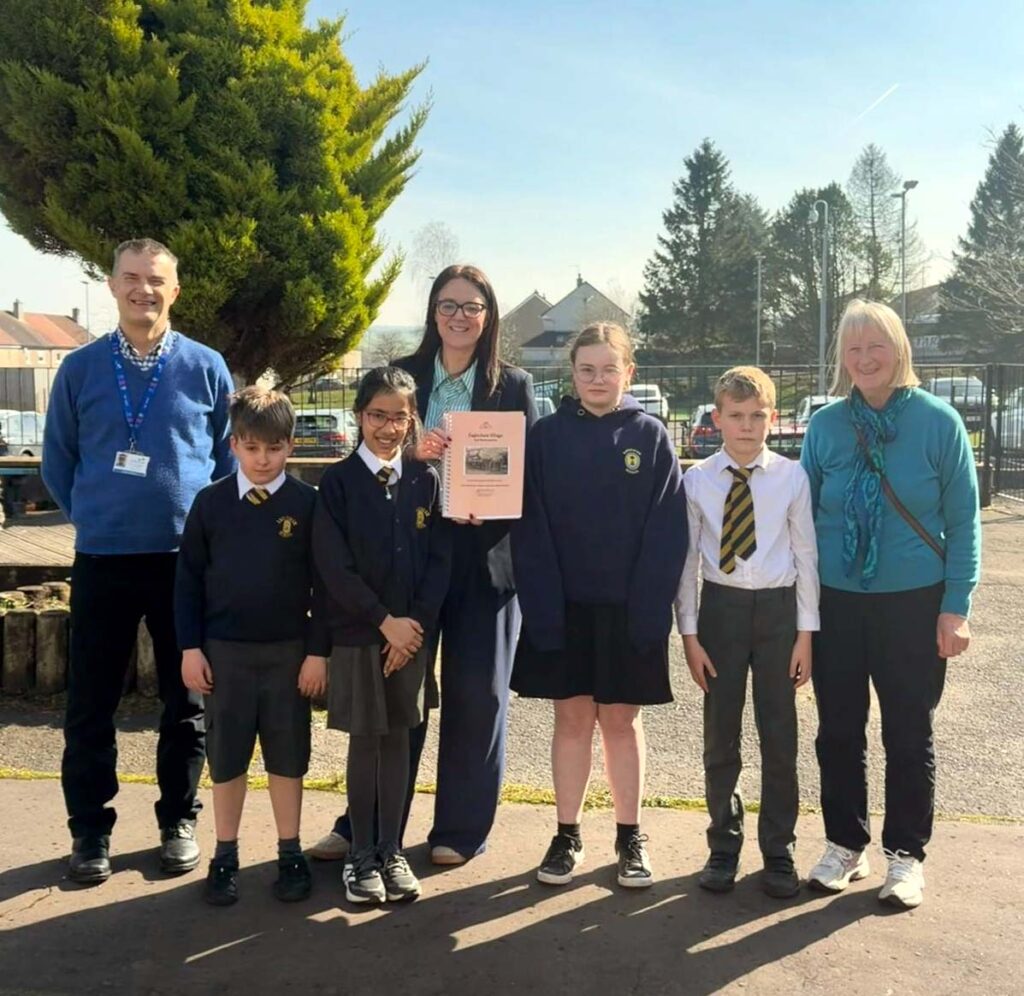
Susan Hunter and Ken Mallard visited Eaglesham Primary School recently to present them with a copy of our latest occasional paper, Eaglesham Village, an Archaeological Building Survey. Publication costs were generously supported by AOE Windfarm Community Fund.
We are delighted to announce the publication of our latest book Two Headlands, The Archaeology of Ben Hynish and Kenavara, Isle of Tiree.Two Headlands reports on the first major archaeological programme on Tiree for 60 years. The core of this eight-year project has been the methodical recording of the landscape archaeology of two headlands on Tiree, Ben Hynish and Kenavara. The work has been carried out by members of ACFA – Field Archaeology for All/Arc-eòlas do na h-uile with the support of a number of professional archaeologists.
The work is a testament to the skill and dedication of a team of largely non-professional archaeologists and represents an important contribution to our understanding of the archaeology of the region. Lavishly illustrated with 482 illustrations this is a book for anyone interested in the archaeology of Tiree and of the Hebrides more generally.
With contributions from Ann Clarke (lithics), Ann MacSween (pottery), Darko Maričević (archaeological overview), Bob Chambers (farm to township history), Diana Zilioli (soil analysis), Heather James (excavation), Ailsa and Ed Smith (field dykes).
Authors: John Holliday and Dugald MacInnes Format: A4 ISBN: 978-1-0681997-0-7 Pages: 461 Illustrations and photographs: 482 Tables: 32
Two Headlands: The archaeology of Ben Hynish and Kenavara, Isle of Tiree
Two Headlands reports on the first major archaeological programme on Tiree for 60 years.
The core of this eight-year project has been the methodical recording of the landscape archaeology of two headlands on Tiree, Ben Hynish and Kenavara. The work has been carried out by members of ACFA – Field Archaeology for All/Arc-eòlas do na h-uile with the support of a number of professional archaeologists. Although the Royal Commission surveyed the area in the 1970s, over 800 archaeological features were recorded for the first time. The most interesting are presented here. These features range from late prehistoric cairns to five Iron Age duns and forts; an Early Christian eremitic monastery; medieval houses; huts and shieling settlements; kelp processing sites; an aqueduct built by Alan Stevenson in 1843; and sheepfolds dating from the second half of the nineteenth century.
Using a novel methodology, a detailed survey of the field dykes covering Ben Hynish has also revealed several overlapping field systems. A network of orthostatic dykes covers the 330-hectare site. It is suggested that these may be late prehistoric. The survey has also revealed Tiree’s only surviving medieval hill farm, and a soil survey has shown that its closed fields contain deep plaggen-type soils.
Almost 5000 worked lithics were recovered. Analysis shows that these date from the Late Mesolithic to the Bronze Age. The recovery of a possible Late Upper Palaeolithic crested blade supports earlier evidence that some of the first people to settle Scotland after the last Ice Age visited Tiree. A number of coarse stone tools were also found, including the island’s first documented Skaill knife. The discovery of a number of trough querns shows that the Bronze Age people who lived on Ben Hynish grew cereals. The ceramics found in the survey areas included some diagnostic Iron Age material. A limited excavation of the midden of one of the duns has recovered material dated securely to the Iron Age and a possible pottery gaming piece.
The book also includes the first full account of the island’s prehistory, a detailed history of the two headlands and their surrounding settlements, and an analysis of the place-names and oral traditions of Ben Hynish.
The work is a testament to the skill and dedication of a team of largely non-professional archaeologists and represents an important contribution to our understanding of the archaeology of the region. Lavishly illustrated with 482 illustrations, some using a drone, this is a book for anyone interested in the archaeology of Tiree and of the Hebrides more generally.
With contributions from Ann Clarke (lithics), Ann MacSween (pottery), Darko Maričević (archaeological overview), Bob Chambers (farm to township history), Diana Zilioli (soil analysis), Heather James (excavation), Ailsa and Ed Smith (field dykes).
Costs £40 including P&P to UK addresses. For delivery to the rest of the world, or for orders of more than one copy, please contact us.
After a break of a few years, ACFA has returned to surveying in the Kilsyth Hills under the directorship of Dugie MacInnes. We are using these day surveys as a great opportunity to give some of our members in-the-field survey training.
The general objective of archaeology is to generate reliable knowledge of the ways of life of past communities. This requires inference from physical evidence obtained not only from under the earth by excavation, but also from the surface of the earth by direct observation in situ, ‘in the field’. The specialist field archaeologist forgoes the recovery of artefacts, evidence of the site’s stratigraphy and of the way in which different contexts of use relate to each other in the vertical profile. Instead, the field archaeologist’s work is limited to observation, recording and reporting surface remains. But the quicker coverage of an extensive area can usefully picture the distribution of human activity in the landscape and indeed identify particular sites worthy of subsequent excavation.
With evidence of this kind, the field archaeologist is constantly faced with problems of dating and interpreting features, as these are usually, but not exclusively, gained through careful examination of artefacts and site stratigraphy, backed up by laboratory-based investigations employing radiocarbon dating, soil analysis and other techniques. But tentative interpretation and rough dating of some features found in the field can be made through comparison with excavated sites, or with unexcavated sites which have been interpreted by a specialist archaeologist. Dating of more recent features can come from local knowledge; from the study of maps; and by documentary research. However, very limited surface evidence of the earliest communities will be accessible to the field archaeologist: the annual cycle of vegetation growth and decay is a soil-creating process, so the accretion of additional soil layers gradually buries early archaeological evidence.
With its dependence on acute observation, two factors can constrain or aid field archaeology: the condition of vegetation and the available sunlight. Most fieldwork is undertaken in early spring with the vegetation at its lowest. Good light is also crucial: the oblique angle of low morning or late afternoon winter sun can often reveal features that would otherwise have been overlooked.
The survey technique normally used by ACFA is the tape-offset method, usually involving teams of three. It measures what is visible on the ground and ‘translates’ these measurements onto board-mounted waterproof tracing-paper, backed by graph paper printed with a 1cm grid, divided further into 10 millimetres. A scale is chosen for the drawing, frequently of 1:100, although scales of 1:1000; 1:200, 1:50 and 1:20 are sometimes employed. At a scale of 1:100, a metre length on the ground would be recorded on the tracing paper as 1cm. The tape-offset method uses two tapes: a longer one forms the straight baseline, normally run out through the middle of the feature or site, overlapping it slightly at each end, fixed firmly to the ground. This is drawn to scale on the board. A second short tape (the offset) is used to take measurements in sequence from points on the baseline – crucially at right angles to it – to selected points on the feature, along both sides of the baseline. The team member tasked with drawing ‘translates’ each pair of measurements (along the baseline and along the offset) into a point on the tracing paper. When all the selected measurements have been recorded, the feature is drawn by ‘joining the dots’, interpolating the intervening unmeasured dimensions of the feature, and adding impressions of other aspects of the site, using conventional symbols (e.g. hachures for slopes). The feature is also carefully located in the landscape (‘georeferenced’). Its orientation is recorded by a compass-bearing taken along the baseline, and a Global Positioning Satellite (GPS) instrument is used to provide a location in terms of the National Grid. So, the feature can be found again on a later visit or by other researchers.
At the end of the survey the completed field drawings are carefully ‘inked up’ on tracing paper, using a fine waterproof-ink pen, and scanned for insertion into the Survey Report, with the feature’s locational data and a verbal description of it, and often a digital image.
This website uses cookies to improve your experience. We'll assume you're ok with this, but you can opt-out if you wish.AcceptRejectRead More
Privacy & Cookies Policy
Privacy Overview
This website uses cookies to improve your experience while you navigate through the website. Out of these, the cookies that are categorized as necessary are stored on your browser as they are essential for the working of basic functionalities of the website. We also use third-party cookies that help us analyze and understand how you use this website. These cookies will be stored in your browser only with your consent. You also have the option to opt-out of these cookies. But opting out of some of these cookies may affect your browsing experience.
Necessary cookies are absolutely essential for the website to function properly. This category only includes cookies that ensures basic functionalities and security features of the website. These cookies do not store any personal information.
Any cookies that may not be particularly necessary for the website to function and is used specifically to collect user personal data via analytics, ads, other embedded contents are termed as non-necessary cookies. It is mandatory to procure user consent prior to running these cookies on your website.